RockHound GO › AI Mineral Identification
AI Mineral Identification — Scan Any Rock or Mineral
RockHound GO uses computer vision paired with Mindat.org crystallographic reference data to identify rocks, minerals, crystals, fossils, and gemstones from a photo. Review confidence scores, ranked alternate candidates, and field tests — and unlock your first Liquid Mineral Badge immediately.
Collecting Limits: BLM casual hobby limit is 250 lbs/year (personal use, common minerals/invertebrate fossils; petrified wood 25 lbs/day + 250 lbs/yr) · National Parks (NPS) strictly ban all collecting (36 CFR § 2.1) · Not a permit · Stealth Mode geo-fuzzing keeps exact coordinates private.
Interactive Identification Report Preview
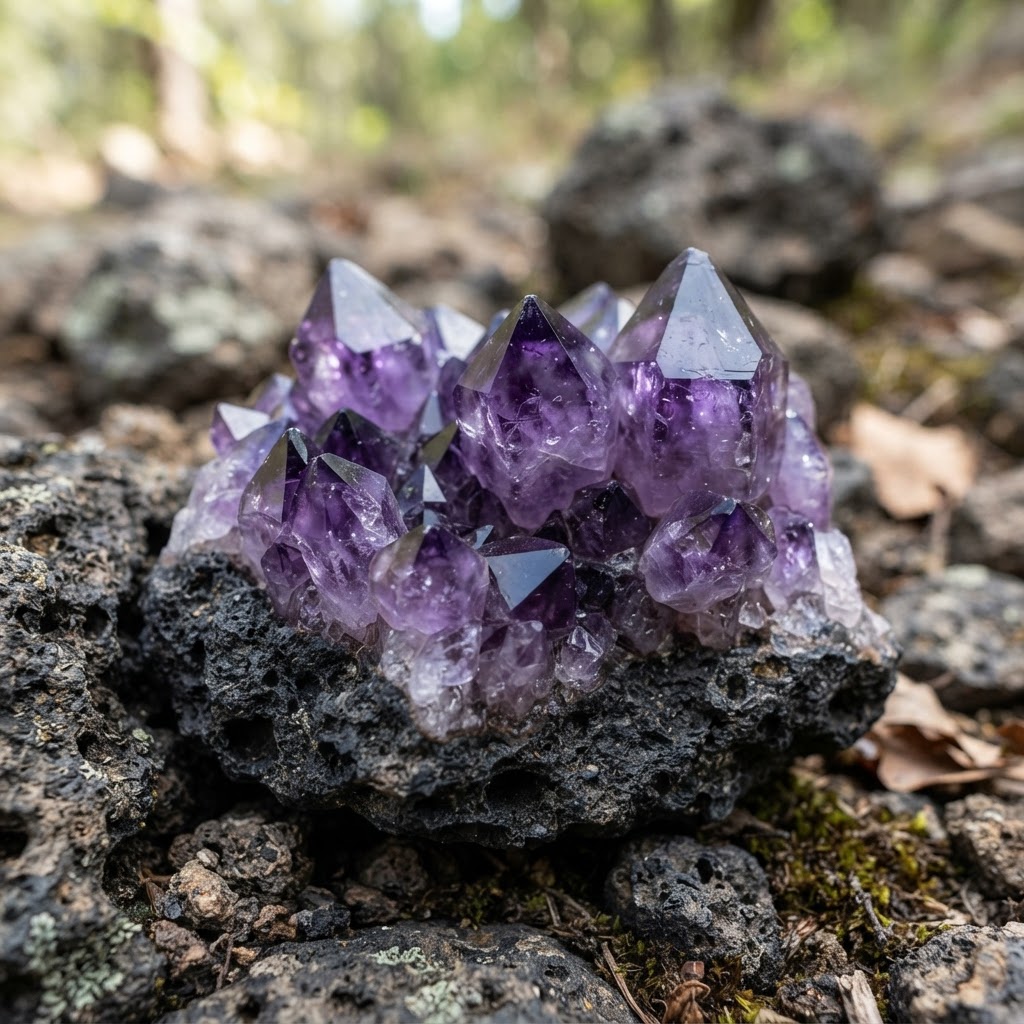
Amethyst (Quartz Variety · SiO₂)
Hexagonal prismatic quartz crystals showing violet iron-coloration zoning, vitreous luster on prism faces, and conchoidal fracture.
Alternate 1: Fluorite (Purple, 18%) — ruled out by Mohs 7.0 steel-blade scratch check (Fluorite is Mohs 4 and exhibits octahedral cleavage).
Alternate 2: Scapolite (Violet, 9%) — ruled out by 6-sided hexagonal prism habit with horizontal growth striations.
How AI Mineral Identification Works
Our AI engine analyzes the visual properties of your specimen — color, luster, crystal system, cleavage patterns, transparency, fracture type, and crystal habit — and cross-references them against mineral property references to suggest likely matches.
Each identification includes a confidence score (0–100%), alternative candidate minerals ranked by likelihood, suggested field tests (streak, hardness, acid test), geological context, formation history, and estimated market valuation range.
What the Rock Identifier Recognizes
- Minerals — Quartz, feldspar, calcite, pyrite, tourmaline, garnet, mica, amphibole, and many more
- Crystals & Gemstones — Amethyst, citrine, obsidian, jade, turquoise, opal, topaz, ruby, sapphire
- Rocks — Granite, basalt, sandstone, limestone, schist, marble, rhyolite, shale
- Fossils — Ammonites, shark teeth, trilobites, plant fossils, trace fossils
- Meteorites — Fusion crust, Widmanstatten pattern, chondrules
What Your AI Identification Report Includes
Frequently Asked Questions
How accurate is AI mineral identification?
RockHound GO's AI engine analyzes visual properties like color, luster, crystal habit, and cleavage to suggest likely mineral matches. Identification confidence is displayed with each result. Common minerals with distinctive features, like quartz and pyrite, are generally identified more reliably than rare species or look-alikes. AI results are a starting point, not a certified identification. We always recommend field tests (streak, hardness, luster) to confirm.
What photo should I take for the best identification?
Use natural light, fill the frame with the specimen, include a fresh broken surface if possible, and take 2-3 angles. Avoid heavy shadows and blurry macro shots. The AI engine analyzes color, luster, crystal habit, cleavage, and fracture patterns.
Can I identify fossils and gemstones too?
Yes. RockHound GO identifies minerals, rocks, crystals, fossils, and gemstones. The AI categorizes finds into igneous, sedimentary, metamorphic, mineral, crystal, fossil, and gemstone families.
Is the mineral identification free?
Yes — all AI mineral identification scans and Mindat.org reference lookups are free for both guests and signed-in accounts. Paid plans unlock offline field packs, advanced map layers, trip planning, and valuation tools.
Does it work offline in the field?
The scan capture works offline. Identification results sync once you reconnect. Crystal Pro and Expedition Elite users can pre-cache field data for fully offline operation.
We use analytics cookies to see which features help rockhounds most. No ads, and we never sell your data. Privacy policy